Sep 8, 2026Custom Bronze Sculpture
How Long Does a Custom Bronze Sculpture Take? A Realistic Project Timeline
How long does a custom bronze sculpture take? See realistic lead times for design, mold making, casting, patina, production, QC, and shipping.
How Long Does a Custom Bronze Sculpture Take? A Realistic Project Timeline
Meta Description: How long does a custom bronze sculpture take? See realistic lead times for design, mold making, casting, patina, production, QC, and shipping.
When you're planning a custom bronze sculpture, the first question is usually not about the casting method or the patina.
It's "When can we have it?"
That matters whether you're ordering a single bespoke sculpture, developing a new product line, planning a hotel installation, or placing an OEM production order. A missed delivery date can affect an opening, exhibition, marketing launch, trade show, or retail release.
The problem is that there isn't one fixed lead time for every bronze project.
A small sculpture with an approved design and straightforward finish is very different from a large, highly detailed piece that requires new modeling, complex molds, multiple sample revisions, and international shipping.
This guide explains how the timeline actually works and where projects usually gain or lose time.
How Long Does a Custom Bronze Sculpture Take?
For a typical B2B custom bronze sculpture project, 8–16 weeks is a realistic working range from approved design through production and shipment.
That range is not a guarantee. Larger sculptures, complex designs, multiple pieces, extensive finishing, or additional approval rounds can push a project beyond 16 weeks.
A project may move faster when:
- The design is already production-ready
- Dimensions and specifications are clearly defined
- No major design development is required
- The first sample is approved
- The quantity is manageable
- Client feedback is provided quickly
- The required finish is already established
It may take longer when:
- The sculpture requires original 3D modeling
- The design contains complex undercuts or multiple sections
- A new master and mold system must be developed
- Several sample revisions are required
- The project involves a large production quantity
- The sculpture is oversized or structurally complex
- The project falls during a major factory shutdown or peak production period
For that reason, we recommend planning the project around a working schedule, rather than treating a quoted number of weeks as a fixed promise.
The Main Stages of a Custom Bronze Project
A custom bronze sculpture doesn't go directly from a drawing to a finished casting.
There are several stages between the first project brief and the final shipment, and the amount of time spent at each stage depends heavily on the project.
1. Project Brief and Initial Review — 1–5 Business Days
The process usually starts with a drawing, reference images, existing 3D files, product specifications, or simply an idea of what you want to create.
At this point, the manufacturer needs to understand more than the appearance of the sculpture.
Size, intended use, quantity, finish, installation requirements, target delivery date, and whether the piece is for a one-off commission or an OEM/ODM product line can all affect the production approach.
A clear project brief makes this stage much faster.
If the initial information is incomplete, expect a few rounds of questions before the scope can be properly defined.
Typical timeframe: 1–5 business days.
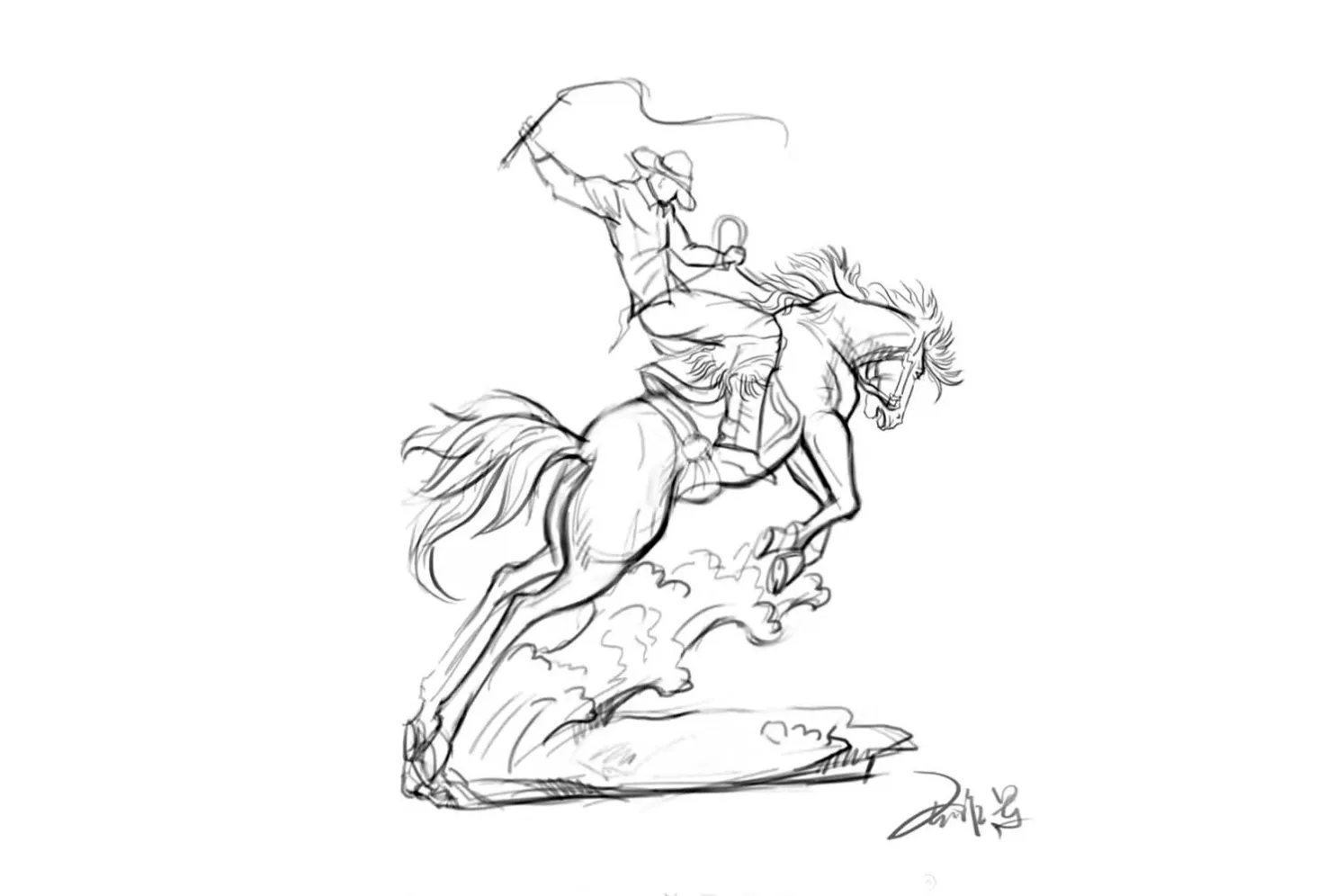
2. Design Development and 3D Modeling — 1–3 Weeks
If you already have a production-ready 3D model or an existing sculpture to reproduce, this stage may be relatively short.
If the project starts from sketches, photographs, or a general concept, more development may be required.
The manufacturer may need to prepare:
- Concept drawings
- 3D models
- Rendered views
- Dimensioned specifications
- Structural adjustments
- Production details for casting
This is also where design revisions happen.
One or two rounds of feedback are normal for a bespoke project. The more changes made after approval, the more the schedule moves.
For B2B projects with a fixed launch date, quick feedback is one of the easiest ways to keep the project moving.
Typical timeframe: 1–3 weeks.
3. Master Pattern, Mold Making and Wax Pattern — 1–2 Weeks
Once the design is approved, the production team can prepare the master and mold system for lost-wax casting.
This is one of the most important technical stages of bronze sculpture production.
The mold has to capture the details of the original model while also allowing the sculpture to be cast successfully. Complex forms, deep undercuts, hollow sections, multiple components, and large sculptures can all require more complicated mold construction.
After the mold is prepared, wax patterns are produced and checked before the bronze casting stage begins.
A small, uncomplicated sculpture can move through this stage relatively quickly. Large or highly detailed work may require more time.
Typical timeframe: 1–2 weeks for a standard project.
4. Sample Casting and Approval — About 2–4 Weeks
For OEM, ODM, and repeat production projects, sample approval is often one of the most important checkpoints.
The first sample allows the client to evaluate the actual physical result rather than relying only on drawings or renderings.
Depending on the project, this may include checking:
- Overall proportions
- Surface details
- Casting quality
- Dimensions
- Assembly
- Base or mounting
- Patina colour
- Surface texture
- Branding or engraving
If the sample meets the agreed requirements, production can move forward.
If something needs to change, the schedule moves with it.
A minor finishing adjustment may be relatively quick. A significant change to the model, mold, or casting may require considerably more time.
For this reason, it is safer to allow some approval buffer instead of assuming the first sample will be accepted immediately.
Typical timeframe: 2–4 weeks, depending on the sample and approval process.
5. Bronze Casting, Finishing and Production — 3–8 Weeks
Once the sample is approved, full production can begin.
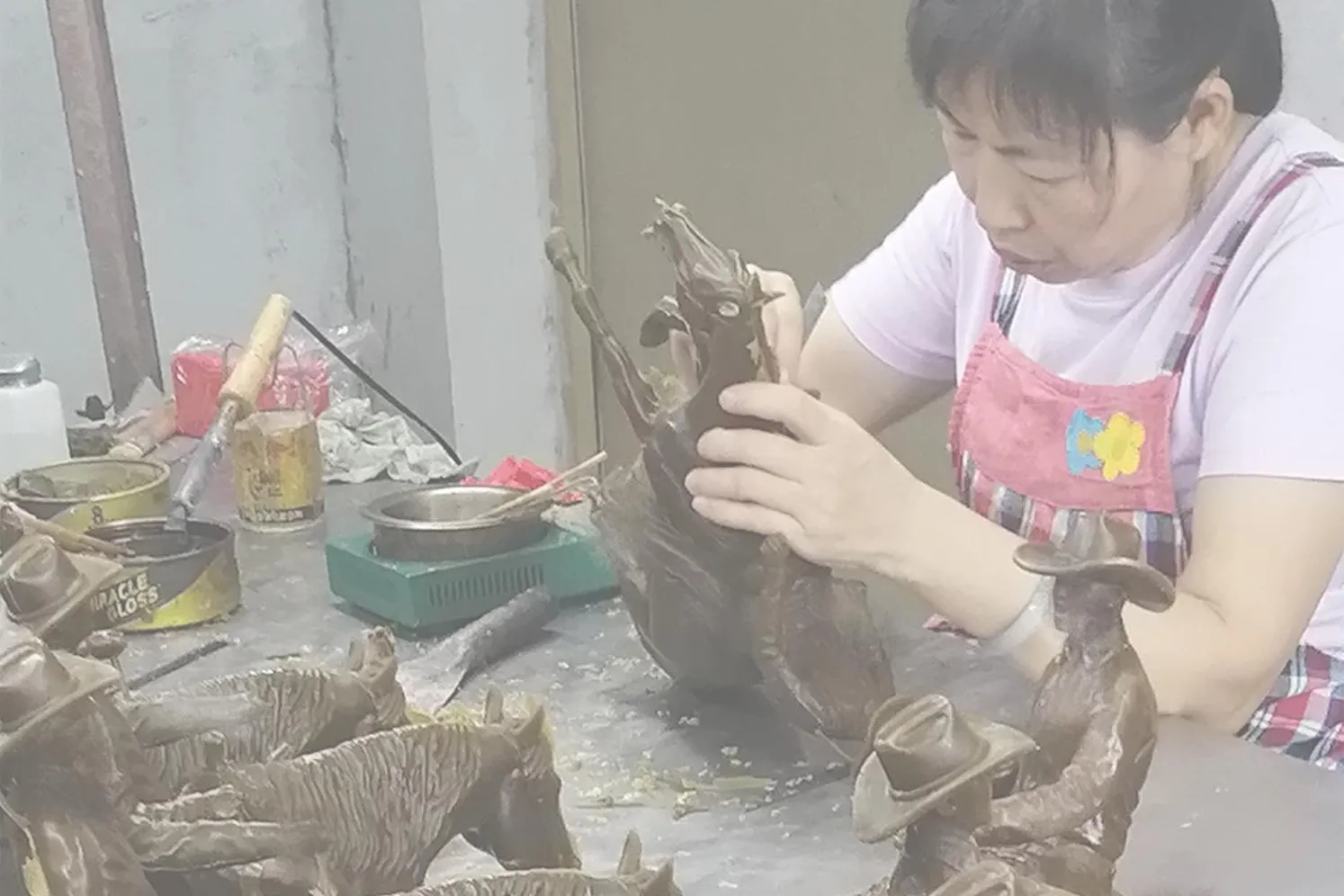
This is where the physical manufacturing work takes place: wax preparation, casting, cutting and chasing, welding where required, grinding, polishing, surface finishing, patination, assembly, and final detailing.
For a custom bronze sculpture manufacturer, production time depends on much more than the number of units.
A small run of relatively simple pieces may move quickly. A smaller number of large, highly detailed sculptures can actually require more production time because each piece involves more casting and hand-finishing work.
Quantity, scale, design complexity, number of components, and finishing requirements all matter.
For OEM orders, production planning can also be different from a one-off bespoke commission because several pieces may be processed through the same production stages.
Typical timeframe: 3–8 weeks.
6. Final Quality Control, Packing and Shipment — About 1–2 Weeks
Before the sculpture leaves the workshop, the finished pieces are checked for appearance, dimensions, surface finish, assembly, and packaging requirements.
For larger sculptures, export packing also needs to be planned carefully.
The packaging method depends on the sculpture's size, structure, weight, number of sections, and destination.
International freight should be treated as a separate part of the schedule.
Ocean freight can take several weeks depending on the route and destination, while air freight is considerably faster but usually more expensive.
This is why the date the sculpture leaves the factory and the date it arrives at your location should not be treated as the same deadline.
Typical factory-side timeframe: 1–2 weeks, excluding transit time.
What Usually Causes a Custom Bronze Project to Take Longer?
In our experience, delays are rarely caused by one single step.
They usually come from several small changes accumulating throughout the project.
Design revisions
Changing the design after modeling has started can affect the 3D model, mold, wax pattern, and sometimes the casting process itself.
Sample changes
If the first sample is not approved, another round of work may be necessary. Changes to proportions, details, patina, or structure can all affect the schedule differently.
Slow approvals
This is one of the simplest delays to avoid.
If a design, sample photo, or finish needs your approval, the production schedule cannot move forward until a decision is made.
A two-day approval delay may not seem significant, but several approval delays across a project can add weeks.
Complex sculpture construction
Large sculptures, multi-part pieces, enclosed forms, deep undercuts, and complicated assemblies generally require more production planning than a simple solid form.
Quantity
A 1-piece commission and a 50-piece OEM order should not be expected to have the same production schedule.
However, production time does not necessarily increase in direct proportion to quantity. Once molds, tooling, and production procedures are established, multiple pieces can often be processed more efficiently as a batch.
Peak production periods
Foundries can become busier during certain parts of the year, especially when multiple commercial, hospitality, award, or retail projects are being completed at the same time.
Chinese New Year is another important consideration for projects manufactured in China. Factory operations normally pause around the holiday period, so projects crossing this period should be planned in advance.
Can a Custom Bronze Sculpture Be Made Faster?
Sometimes.
But speeding up a bronze project does not mean removing steps that are necessary for quality.
The easiest time savings usually come from better preparation and faster decision-making, rather than simply asking the foundry to work faster.
You can often shorten the schedule by:
- Providing complete reference materials at the beginning
- Confirming dimensions early
- Supplying production-ready 3D files when available
- Limiting unnecessary design revisions
- Giving consolidated feedback rather than multiple separate changes
- Approving samples promptly
- Confirming the patina and finish before production
- Planning shipping before the production is complete
For urgent projects, additional production capacity or expedited logistics may also be possible depending on the factory schedule.
However, not every stage can be compressed indefinitely.
Casting quality, mold preparation, hand finishing, patina application, inspection, and packaging all require sufficient time. Rushing these stages can create problems that cost more time to correct later.
How to Plan Backward From Your Delivery Date
If your project has a fixed deadline, don't start by asking, "How quickly can you make it?"
Start with the date you need the sculpture in your hands.
Then work backward.
For example:
Required delivery date
↓
International transit
↓
Final QC and export packing
↓
Bulk production
↓
Sample approval and revisions
↓
Mold and wax preparation
↓
Design development
↓
Project briefing
This approach gives you a much more realistic view of the schedule.
If the deadline is connected to a hotel opening, exhibition, trade show, retail launch, corporate event, or public installation, tell the manufacturer that date at the beginning of the project.
A good production schedule should be built around the actual deadline, not added after production has already started.
A Simple Example of a 12-Week Project
For a relatively straightforward custom bronze sculpture project, a schedule might look something like this:
Project Stage | Typical Time |
|---|---|
Project brief and technical review | 1–5 business days |
Design / 3D modeling | 1–3 weeks |
Mold and wax preparation | 1–2 weeks |
Sample casting and approval | 2–4 weeks |
Bulk production | 3–8 weeks |
Final QC and packing | 1–2 weeks |
International shipping | Additional time |
These stages can overlap in some projects, while others need to be completed sequentially.
That's why a manufacturer should provide a project-specific production schedule after reviewing the actual design, quantity, finish, and delivery requirements.
One-Off Sculpture vs. OEM / ODM Production
The timeline can also look different depending on what you're buying.
One-off bespoke bronze sculpture
A one-off commission may require more design development and individual hand-finishing.
The process is usually more focused on creating one specific piece, so the design and approval stages can represent a significant part of the overall schedule.
OEM bronze production
OEM projects are often based on an existing design, sample, drawing, or product specification.
Once the product has been approved and the production process is established, repeat orders can be more predictable.
ODM bronze development
ODM projects typically involve more development work because the manufacturer helps turn a product idea or brief into a finished design.
That means the early design and sample stages can take longer, but the result is a product developed specifically for the client's market or collection.
For buyers building a new bronze product line, this distinction is important when setting launch dates.
The Biggest Mistake Is Planning to the Minimum
If a manufacturer says a project can be completed in eight weeks, that does not necessarily mean you should schedule your launch for eight weeks from today.
There is a difference between a possible production time and a safe project schedule.
A realistic B2B project plan should leave room for:
- Design feedback
- Sample revisions
- Production adjustments
- Peak factory periods
- Packing
- Freight transit
- Unexpected issues
That buffer becomes especially important when the sculpture is part of a larger commercial project.
Project timing and project cost are also closely connected, particularly when additional revisions, complex finishing, or expedited production are involved.
How We Manage Custom Bronze Project Timelines
At Patinara Art, we don't treat every custom bronze sculpture as a standard production item.
Once we understand the design, dimensions, quantity, finish, and delivery requirements, we can build a project schedule around the actual scope.
Our custom manufacturing process covers design development, pattern and mold preparation, lost-wax bronze casting, hand finishing, patination, quality inspection, and export preparation.
For OEM and ODM projects, sample approval is also built into the production process before bulk manufacturing begins.
We keep clients updated during the major stages and flag potential delays as early as possible. That gives you time to make a decision rather than discovering a schedule problem when the delivery date is already approaching.
What Should You Send a Bronze Sculpture Manufacturer?
If you want an accurate production timeline, the more useful information you can provide at the beginning, the better.
Ideally, send:
- Reference images or sketches
- 3D files, if available
- Approximate dimensions
- Quantity
- Intended application
- Indoor or outdoor installation
- Preferred bronze or metal finish
- Patina reference
- Base or mounting requirements
- Target delivery date
- Shipping destination
You don't need to have every detail finalized before contacting a manufacturer.
A good custom bronze sculpture manufacturer should be able to tell you which information is essential and which decisions can be made later.
Final Takeaway
For many B2B custom bronze sculpture projects, 8–16 weeks is a reasonable starting point from approved design through production and shipment.
But the number that matters is not a generic industry average.
It is the timeline for your sculpture.
Size, design complexity, mold requirements, quantity, finishing, sample revisions, factory capacity, and shipping destination can all change the schedule.
If you have a fixed deadline, the safest approach is to start early, provide a clear project brief, keep approval cycles moving, and build some buffer into the schedule.
The earlier a bronze sculpture manufacturer understands your design and delivery requirements, the easier it is to give you a realistic production plan.
Planning a custom bronze sculpture, OEM product, or ODM project? Send us your drawings, reference images, dimensions, or project brief, and we can review the production requirements and provide a realistic timeline for your project.