Sep 18, 2026Material Notes
Hot Patina on Bronze | Material Science Behind the Finish
Hot patina isn't paint—it's a chemical bond between pigment and metal. Learn how the alloy, heat, and hand-applied solutions create museum-grade finishes that age beautifully.
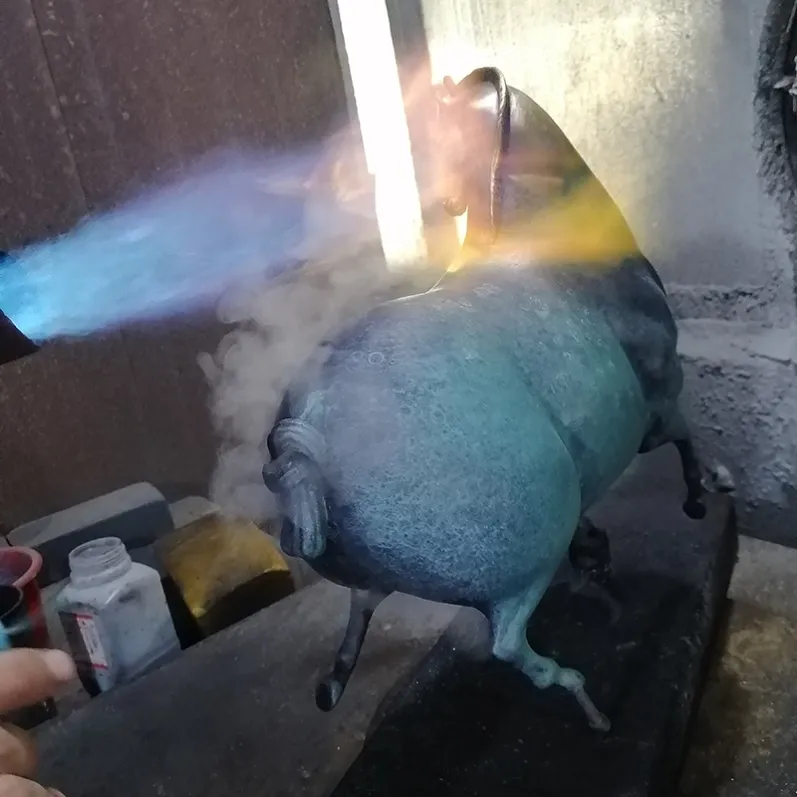
You've probably seen it in a gallery, a designer's showroom, or a well-kept courtyard garden. A bronze sculpture that doesn't look painted—the color seems to come from inside the metal, warm and layered, shifting as you walk around it. You stop. You lean in. You might even reach out to touch it, because it doesn't feel like a coated object. It feels like it has a surface that breathes.
That effect is hot patination. You can see it in pieces like our hot-patina bronze composer statue, where the warmth of the metal brings the figure to life.
It's not paint. It's not a cold chemical dip. It's a process that uses heat and mineral-based solutions to trigger an oxidation-reduction reaction on the metal surface. The color grows into the microscopic pores of the metal—it doesn't sit on top. That's why it won't peel, won't scratch white, and won't fade into that chalky, lifeless pink that cheap spray finishes do.
And here's the part that surprises most people: every piece is one of a kind. Flame temperature, solution concentration, dwell time—tiny variations in any of these produce completely different results. The same recipe on two pieces will give you a deeper green on one, a redder brown on another, a different gradation in the transition zone. Collectors aren't buying a finish. They're buying that particular piece's particular moment under the torch.
The alloy matters more than the recipe. We use a closely controlled brass alloy, formulated specifically for hot patination. The same alloy is used across our full range of cast brass sculptures with hot patina finish
Most people obsess over the patina formula. What ratio gives emerald green? Which salts produce that antique bronze tone?
Here's what I've learned after years of doing this: if your brass alloy is low-grade, no recipe will save it.
Impure alloys react unpredictably. Blotchy dark spots. Pale patches that won't take color. Sometimes even blisters forming under the flame. The reaction jumps around because the metal density isn't consistent.
We cast in brass, selected specifically for hot patination. It does three things that matter:
- Reacts evenly. Uniform density means heat transfers smoothly, so the solution bites consistently—no over-reaction in one spot, under-reaction in another.
- Holds fine detail. The alloy we use is ductile enough to preserve fine carving—hair strands, feather veins, fabric folds—without cracking under heat. Lower-grade metal fissures the moment the temperature climbs, and all that carving work goes to waste.
- Ages well. Brass already resists corrosion. Hot patina adds another dense oxide layer on top. Outdoors, it holds up better than iron or mild steel—not that it never changes, but the change is slow, even, and usually beautiful.
Hot patina vs. paint and cold dips
Spray paint is a skin. It sits on the surface. Three years outdoors and it cracks.
Cold patina—the room-temperature chemical dip—does bond with the metal, but only at the very surface. Rain and handling wash it out over time. And the color tends to look dull and flat, without the translucent depth that hot patina gives.
Hot patina is different because the color is fused into the metal, not layered on top. And here's the thing I keep coming back to: it gets better with age.
Paint fades to white or chalky pink—ugly, obvious, cheap. Hot patina, as it oxidizes naturally over the years, deepens. Greens pick up a subtle copper-rust tone. Browns get richer. I once saw a courtyard sculpture that had been outdoors for twelve years. It looked more interesting than the day it was finished—streaked with soft green and brown, layered in a way that no factory finish could replicate. The owner told me visitors always ask about that one first.
The real cost is in the hands, not the materials
Hot-patina bronze is expensive because of what it takes to make it.
A skilled artisan can only finish two or three pieces in a day. Each one requires full concentration, because a few degrees too hot and the color shifts permanently. There's no undo button. No repainting. You live with what the fire gives you.
That's not a limitation. That's the point.
It's not a process built for mass production. Which means it's not a process built for sameness. Every piece that leaves the workshop is genuinely unique—not as a marketing claim, but as a fact of the craft.
One last thing. That realness—the fact that you can see the hand in it, the fact that no two will ever be the same—is probably what draws people to it most. If you have a project in mind, request a custom patina sample and we'll walk you through the process.
Hot patination isn't magic. It's a conversation between fire and metal. The craftsman is just the one controlling the rhythm. Every layer of color is a compromise and a surprise, worked out through trial and adjustment.
That realness—the fact that you can see the hand in it, the fact that no two will ever be the same—is probably what draws people to it most.
The author runs a bronze foundry and has been working with hot patina for over a decade.