Jul 8, 2026Material Notes
More Than Objects: The Quiet Alchemy of Lost-Wax, Enamel, and Fire
Three ancient techniques—lost-wax, cloisonné, and fire patina—unite in every piece. Handmade, unique, and built to age with grace. A quiet rebellion against the mass-produced.
We live in a world of perfect duplicates. Machines can spit out a thousand identical rings before your coffee gets cold. They’re smooth, consistent, and utterly forgettable. But if you’ve ever held a piece of metal that felt alive—that had a slight unevenness in its curve, a depth of color you couldn’t quite place, a weight that seemed to hum with its own history—you know the difference.
That difference is time. And it’s the only ingredient we refuse to compromise on.
We don't manufacture. We translate. We take a handful of ancient conversations—between wax and fire, glass and metal, heat and air—and let them speak through our hands. It’s a slow, messy, deeply human process. And it results in objects that don't just look different. They are different.
Here’s how we get there.
Step One: The Wax That Refuses to Be Copied (Lost-Wax Casting)
Most jewelry and decor today is born from a rubber mold. It’s efficient. It’s precise. And it’s soulless.
Our process begins the way it has for over five thousand years: not with a machine, but with a block of wax and a carving tool. Our artisan doesn’t “design” in the abstract—he sculpts. Every groove, every subtle rise, every tiny imperfection is a decision made in the moment. It’s a physical conversation between the maker and the material.
Once the wax prototype is complete, it’s entombed in a heat-resistant plaster. Then comes the moment of sacrifice: we fire the whole thing at extreme temperatures. The wax melts, burns away, and disappears completely. What’s left behind is a perfect, hollow negative space—a ghost of the original carving. Molten metal is poured into this void.
Here’s the magic: metal, when it cools, has a memory of its liquid journey. It shrinks slightly, flows unevenly, and creates micro-textures that no computer can pre-calculate. The result is a metal skeleton that feels organic, not engineered. It’s a one-off. Always. Because even if the same artisan carved the same wax design twice, it would never be identical. That’s not a flaw; that’s the signature.
Step Two: Coloring Within the Lines of Fire (Cloisonné Enamel)
Now we have a form. But it’s silent. It needs a voice.
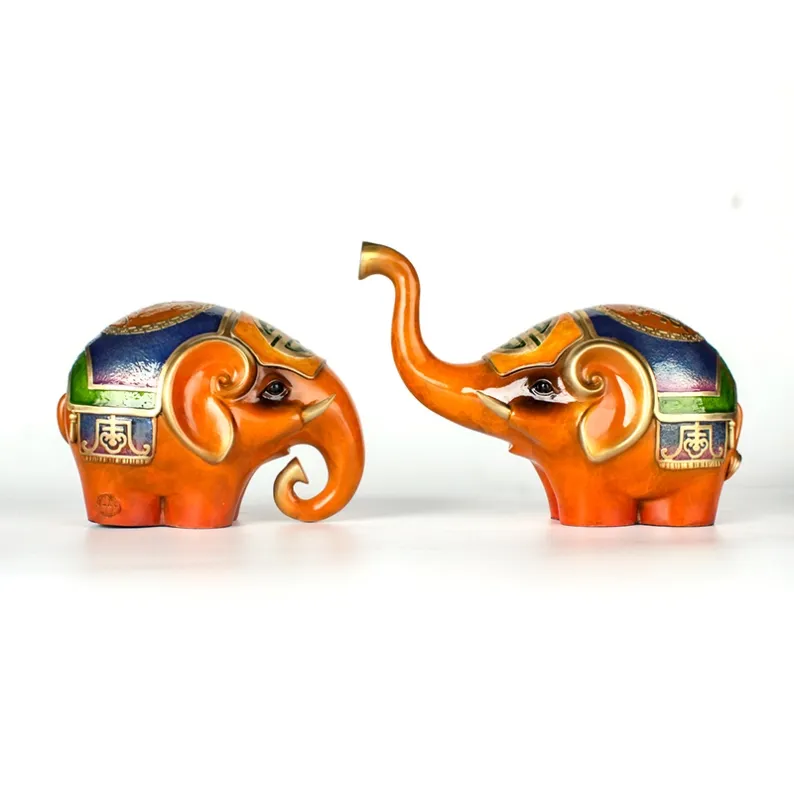
This is where cloisonné enamel comes in—not as a “coating,” but as an act of devotion. The process is almost absurdly laborious: fine metal wires are bent by hand and soldered onto the surface, creating tiny, intricate fences. These aren’t just decorative outlines; they are prisons for color.
Then comes the glazing. Powdered mineral glass is painstakingly packed into each tiny cell. Into the kiln it goes, at hundreds of degrees. It melts, bubbles, and settles. It shrinks. So we fill it again, and fire it again. And again. Dozens of cycles. Polish. Fire. Fill. Fire.
Most people don't realize that enamel is not paint; it’s glass that has permanently fused with the metal beneath. It won’t scratch off, fade in the sun, or dull with sweat. And because light passes through the translucent layers, it creates a glow that’s almost cinematic—a depth that shifts depending on the angle of the room. You can photograph it a hundred times, but you’ll never capture its full personality in a flat image.
Step Three: Letting Heat Do the Talking (High-Temperature Patina)
At this point, many makers would stop. The piece is cast. It’s colored. It’s finished. But for us, it still feels too new. Too pristine. It hasn’t yet earned its character.
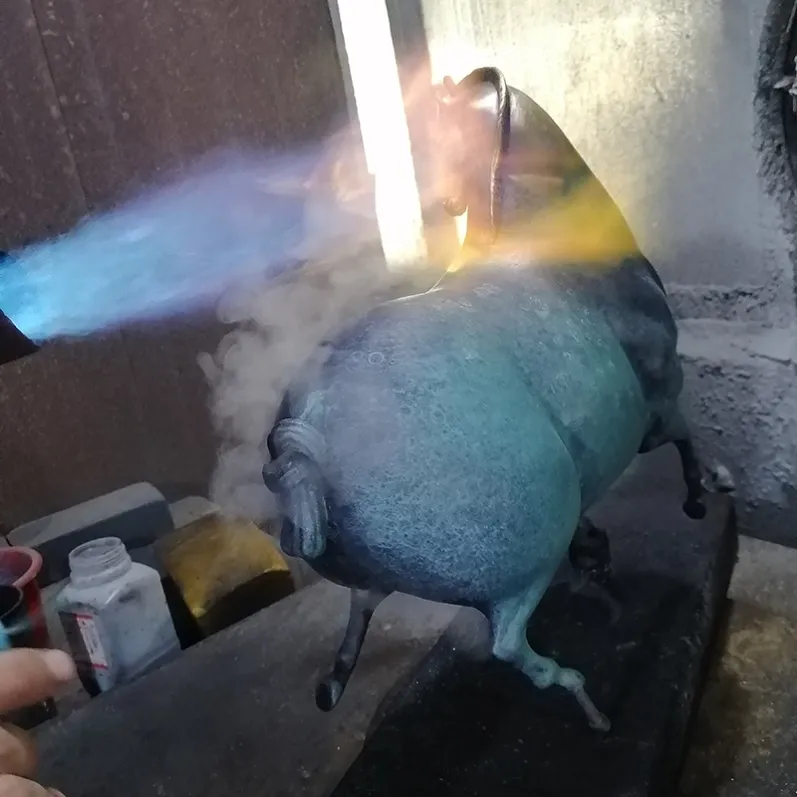
We turn to fire once more, but this time without wax or glass. We apply controlled, graded heat to the metal surface—not to melt it, but to coax it into a reaction. The metal oxidizes naturally, producing subtle shifts in tone and a soft, aged sheen. It’s an organic patina, not a chemical stain. No two pieces ever react the same way.
This isn’t just for aesthetics. The high-temperature process hardens the outer layer of the metal, making it more resistant to the wear of daily life. But here’s the twist: unlike a synthetic coating that eventually peels, this natural patina evolves. It gets richer with age, more complex. It absorbs the oils from your skin, the light of different seasons. It becomes a chronicle of its own existence.
Why We Do All Three (And Why It Matters)
You might wonder why we don’t just pick one technique and call it a day. Because that would be easy. And easy isn’t beautiful.
- Lost-wax gives the piece its structural soul—its uneven, hand-made heartbeat.
- Cloisonné gives it memory—layers of color that were built, not applied.
- Patina gives it time—not frozen in a moment, but alive and aging gracefully.
Together, they form a trifecta that industrial methods can’t replicate. They create objects that belong not to a season, but to a generation. They don't match the decor of a modern minimalist home—they elevate it by standing as quiet, tangible poetry in a sea of digital noise.
The Final Piece Isn’t What We Make. It’s What You Feel.
We don’t claim our work is flawless. There are tiny variations, faint tool marks, and subtle color shifts that reveal the human hand. And that’s exactly the point. In a world obsessed with perfection, we choose to celebrate the imperfections that make something real.
When you wear or display one of our pieces, you’re not just owning an artwork. You’re carrying a fragment of a much longer conversation—one that started with wax, fire, and glass, and will continue as long as you choose to keep it near.
Because truly beautiful things aren’t made in a hurry. They’re made with patience, with fire, and with the stubborn belief that some traditions are worth preserving—not in a museum, but in everyday life.
Ready to hold a piece of that conversation? Explore our collection. Every piece is ready to begin its next chapter—with you.