Sep 17, 2026Material Notes
Hot-Patinated Bronze Sculptures Guide
A craftsman's guide to hot-patinated bronze sculptures. Learn about the process, finishes, and how to choose the right piece for your space.

Walk into a gallery or a well‑kept garden, and you might spot one of these pieces. At first, nothing screams for attention. But then you notice the colour—it’s not painted on, it’s in the metal. In shadow it looks deep and quiet; under sunlight it warms up like old leather. You find yourself stepping closer, maybe even touching it. Not because it’s glossy, but because it feels alive—as if the surface has a kind of skin, soft and breathable.
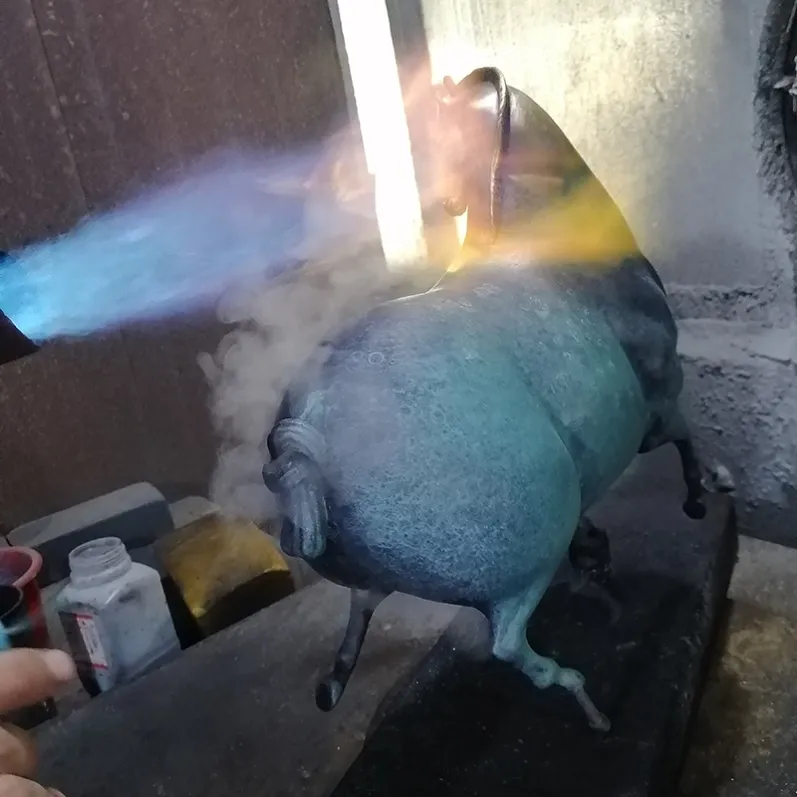
It’s a simple idea, really: heat the brass, brush on a chemical solution, and let it react. The colour grows into the microscopic pores, not on top. So it never peels, never scratches white, never fades into that ugly chalky pink that cheap painted stuff does. And here’s the kicker—it actually looks better with age. I once saw a deer sculpture that had spent twelve years in a courtyard. It was streaked with soft green and brown, far more interesting than the day it was finished. The owner said visitors always ask about that one first.
But the alloy matters more than the recipe
Most people obsess over the patina formula—what ratio gives emerald green, which salts produce that antique bronze tone. Truth is, if your alloy is low‑grade, no recipe will save it. Impure alloys react wildly: blotchy dark spots, pale patches, sometimes even blisters under the flame.
We cast in brass, selected specifically for hot patination. It makes a visible difference from the first pass of the torch.
- Heat travels evenly, so the solution “bites” uniformly—no over‑reaction here, no under‑reaction there.
- The metal is ductile enough to hold fine carving—hair strands, feather veins, fabric folds—without cracking under the torch. Cheap alloy will fissure the moment the temperature climbs, and all your carving goes to waste.
- Brass already resists corrosion; the hot patina adds another dense oxide layer, so rain and sun don’t wreck it as quickly as they do iron or mild steel. Not that it never changes—but the change is slow, even, and usually beautiful.
The real process: you can’t fake it with a blowtorch
Some workshops claim they do hot patina. I’ve visited a few. They wave a torch over the piece, splash on some solution, and call it done. The colour shows up, sure—but after a year or two, it’s all blotchy and tired.
A proper job takes two full days just for the patina.
First, surface prep. Castings come with mould lines, pinholes, and sanding marks. You go through grit after grit of sandpaper, buffing wheels, then a fine glass‑bead blast to get an even matte finish. It’s boring as hell, but you can’t skip a single scratch—because that scratch turns into a permanent dark line under heat, and you can’t fix it later.
Then the torch. Not a hardware‑store burner—we use professional temperature‑controlled ones. For an amber‑gold tone, aim for about 280°C on the base metal. For deep green, push to 320°C and then let it drop. You keep the flame moving constantly; pause for a second too long, and it chars. An experienced hand reads the colour shift on the metal and knows when to back off. A newbie with an infrared thermometer is always a step behind.
The chemical mix is made fresh each time. Brush it on hot, hear that faint sizzle, and colour appears instantly. One coat gives a flat tone; most sculptures need layers—a brass‑brown base first, then a green solution dabbed onto selected areas, with the flame turned down to coax out a soft gradient. It’s like painting, except your brush is fire and you can’t erase. Screw it up, and you grind everything off and restart.
After the colour is locked, you can’t cool it fast. It sits in a climate‑controlled room for six hours or more, so the surface stress releases evenly. Skip this, and fine cracks show up years later—too late to fix without redoing the whole piece.
Finally, a clear matte sealant to keep dust off, then a hand‑buff with a cloth wheel to bring out highlights on edges. That’s when the three‑dimensional feel really pops.
How does it stack up against paint or cold staining?
Paint is just a skin. Outdoors, it cracks, peels, and turns pasty within three years. Cold staining (no heat) bonds a little better, but the reaction stays shallow—colours look dull, and rain washes them into streaks after one season.
Hot patination’s real edge: it doesn’t fade; it deepens. Paint fades to ugly pale tones; hot patina slowly oxidises, the greens take on a soft bronze‑rust warmth, and the whole piece grows more mellow. That’s not marketing—I’ve watched it happen over and over.
So why does it cost that much?
Two reasons: hand labour and time.
A skilled artisan can finish only two or three pieces a day, and every one demands total focus. A few degrees off on the torch, a two‑second longer dwell, and the colour shifts completely. There’s no production line, so no two pieces are ever alike.
What you’re paying for isn’t a lump of metal. It’s someone’s years of trial‑and‑error feel for the flame—and all those near‑misses where they almost lost it but pulled it back.
Hot patination isn’t alchemy. It’s just a back‑and‑forth between fire and brass, with the craftsman keeping time. Every layer of colour carries both deliberate choice and happy accident. That honesty—that rawness—is worth more than any fancy tagline.